
Home Packages & Experiences Pricing & Discounts Funding Options FAQ About Me Testimonials Sponsors Book a Presentation

SSL@tornadoalleychasing.com

Funding options

Having a hard time finding funding?

Here are our suggestions to help bring this unforgettable event to your school.

Route one

PTO and PTA funding

The fastest route, and the one that funds this most often.

How to get on the agenda

  1. Find out when they meet. Most PTOs meet monthly and set the agenda a week ahead. Email the president, not the general inbox. Forwarding the website along with a short note may be easier for a teacher than attending the meeting in person.
  2. Ask for five minutes, not a decision. "Can I have five minutes at the next meeting to propose a science assembly?" is much easier to say yes to than a funding request by email.
  3. Bring one page. Print the standards alignment and the pricing page. Boards approve things they can see the shape of.
  4. Name the date. A proposal with a date attached gets voted on. A proposal without one gets tabled.
  5. Mention the 10%. If you are the first school in your district, the discount is a genuine reason to move now rather than next term.
Parents and students together at a school evening event.

PTOs that fund the family evening event tend to rebook it, because attendance is the metric they are judged on.

Routes two, three and four

Money that already exists, waiting for a request

District education foundations

Most districts have one, and most teachers have never used it. They exist to fund exactly this and they hold a standing list of donors and supporters looking for something concrete to attach their name to.

How to use it. Search your district name plus "education foundation". Grant rounds usually open in the fall and again in early spring, awards typically run from $500 to $5,000, and the application is often a single form. Teachers apply directly, without needing the principal to initiate it.
Science and STEM grants

Small STEM enrichment grants are among the least competitive funding in education, because far fewer people apply than you would expect.

Where to look. Your state's department of education STEM programs, NSF-style informal science education funding, and corporate STEM education funds run by regional energy, engineering and technology employers. The published standards alignment is what makes these applications easy: reviewers want to see the performance expectations named, and they are already written for you.

Service organizations

Rotary Clubs, Lions Clubs and Kiwanis all fund youth education as a core part of what they do, and all three are actively looking for local projects.

How to ask. Clubs meet weekly and frequently need a speaker. Offer to come and present the idea for ten minutes at a lunch meeting. Weather safety education is an unusually easy sell to these rooms, because their members remember a local storm. Decisions are often made the same week.

Route five

Local business partners and corporate community sponsors

Certain sectors reliably sponsor weather-safety programming, because the subject sits directly alongside what they do for a living. You are not asking for charity. You are offering a local business a genuinely good piece of community visibility.

Start with the Chamber of Commerce

Your local Chamber is the single most efficient starting point. Its whole purpose is connecting businesses to community activity, its member directory is public, and a short note to the Chamber director asking "which of your members might underwrite a weather safety program at our school?" often produces two or three warm introductions.

Many Chambers also run their own small community grant or education committee.

The sectors that say yes

  • Disaster restoration companies. Storm damage is their business. Sponsoring severe weather education is the most natural community fit they will be offered all year.
  • Insurance agencies. Local agents hold community marketing budgets and are measured on local visibility. Weather preparedness is squarely on message.
  • Roofing contractors. Storm season drives their work. Many are actively looking for community sponsorship that is not another sports banner.
  • Local news and media partners. Station meteorologists already do school outreach. A sponsorship can bring coverage with it, which is worth more to them than the fee.

If a local business wants to be named as a sponsor during the presentation, loop him in for planning so it can be worked into the event.

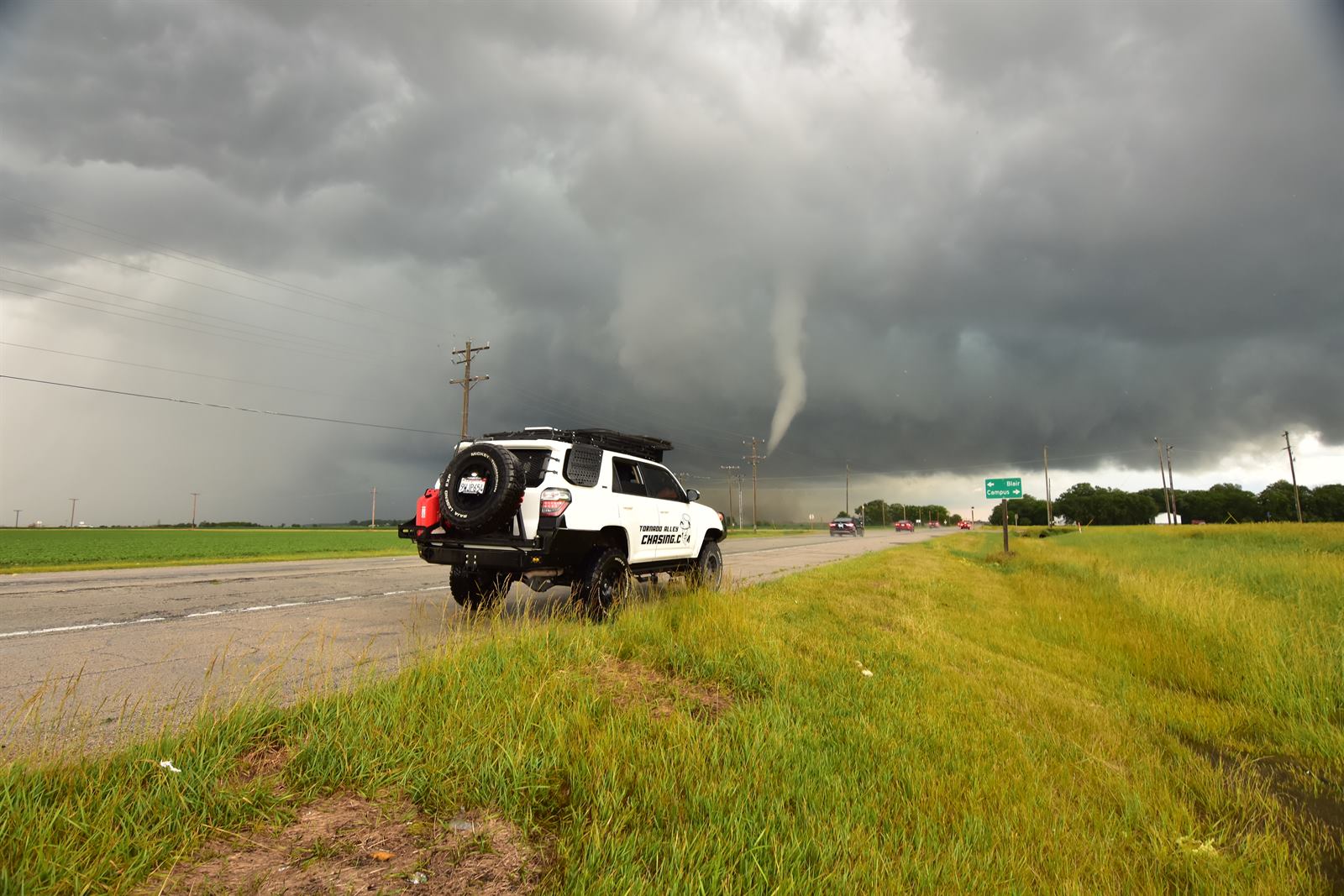
The chase vehicle parked with a tornado in the distance.

Route six

The public-private partnership

A company covers all or part of the event, and the school pays only the remainder. It is a repeatable arrangement, not a one-off favour.

How it works in practice:

  1. The school identifies the business, usually one already connected to the community: a parent's employer, a Chamber member, or a company that has sponsored something at the school before.
  2. The business commits a figure, whether that is the full $1,000, half, or a fixed contribution toward a three-event day.
  3. The school covers the balance, which is now small enough to come from a principal's discretionary fund rather than a board vote.
  4. The sponsor gets named recognition: on event signage, in the parent communication that goes out about the event, and in the take-home materials.
  5. It renews. Once a business has done this and seen the response, the same arrangement the following year is a conversation rather than a pitch.

Businesses interested in a broader arrangement across several schools should look at the Sponsors page, which covers season-long partnerships including vehicle branding.

Use this today

The ask, already written

Copy this, change the bracketed parts, and send it. It works for a business, a service club or an education foundation contact. It is short on purpose, because long asks do not get read.

Sponsorship request template
Subject: Sponsoring a severe weather science program at [SCHOOL NAME] Hi [NAME], I am [YOUR NAME], [YOUR ROLE] at [SCHOOL NAME] here in [CITY]. I am writing to ask whether [BUSINESS NAME] would consider underwriting a science program for our students this year. The program is Severe Storms Lab, run by a former classroom teacher who is also an active storm chaser. He brings real tornado footage he filmed himself, a hands-on vortex demonstration, VR headsets that put students inside a supercell, and a mock weather studio where students deliver a forecast on camera. Every classroom lesson is mapped to grade-level science standards, and it closes on severe weather safety, which for our families is not an abstract topic. It would reach [NUMBER] students at our school on [DATE OR MONTH]. The cost is $[AMOUNT]. If [BUSINESS NAME] were to sponsor it, in full or in part, you would be named on the event signage, in the communication that goes home to every family at the school, and in the take-home materials students bring back. For a local business, that is direct visibility with several hundred households in one day. You can see the full program at severestormslab.com. I am happy to come by and explain it in person, or to answer anything by email. Thank you for considering it. [YOUR NAME] [YOUR ROLE], [SCHOOL NAME] [EMAIL] · [PHONE]

Two things that make this land

  • Attach one page, not five. Print the standards alignment or the pricing page. One attachment gets opened, four do not.
  • Name a real date. "This spring" gets a maybe. "March 12th" gets a decision.

If you get stuck

He will help you write the request

If you need a quote for a grant application, a letter of support, a description of the program in the format your foundation wants, or the standards alignment as a PDF attachment, just ask. It costs nothing and it is a normal part of how schools get this booked.

Next step

Pick one route and start it this week

The PTO route is the fastest. The Chamber route is the most underused. Either way, the ask above is written and ready to send.